
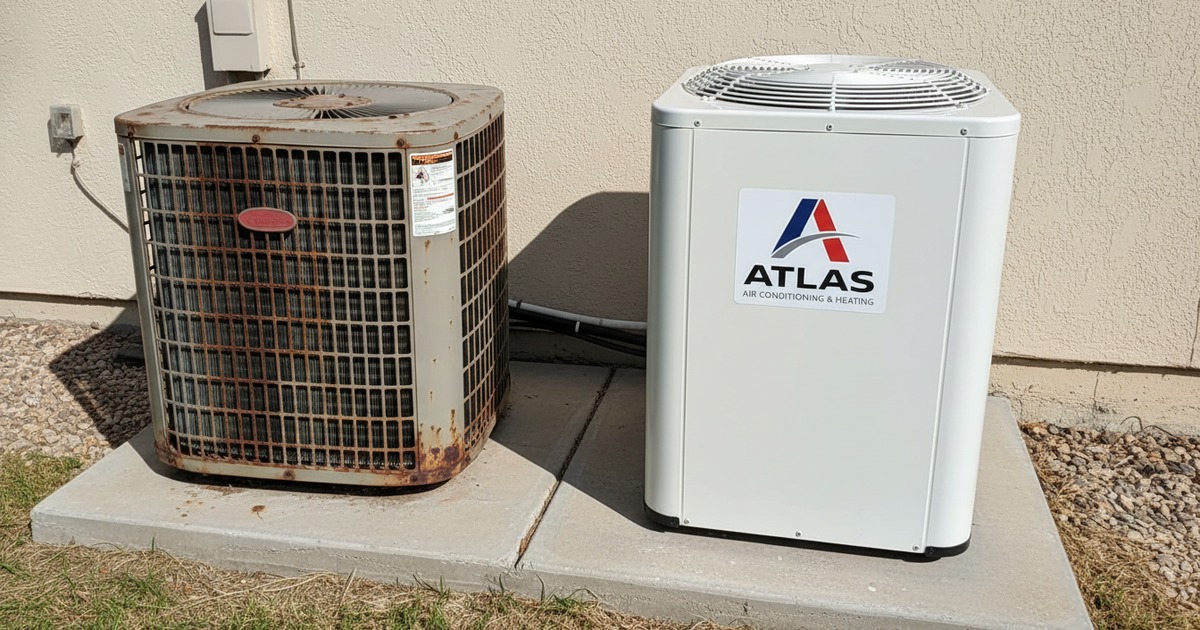
When to Repair vs. Replace Your AC
Houston summers are brutal, and a failing AC is not a decision you want to make at 2 AM when it's 95 degrees. Here's the honest framework we use to help homeowners figure out whether fixing the old unit makes sense — or whether you're throwing good money after bad.
If you live in Houston and your AC is over 10 years old, this question is going to come up. Probably this summer. Probably on the worst possible day.
Most people get bad advice when their unit breaks. They either get pushed into a $12,000 system they don't need, or they keep dumping $700 repair bills into a unit that's two breakdowns away from the landfill. Neither is good.
Here's the framework we actually use.
The 5,000 Rule
Multiply the age of your AC by the cost of the repair. If the number is over 5,000, replace it. Under 5,000, repair it.
TIP: If your unit is 12 years old and the quoted repair is $500, that's 6,000 — lean toward replacement. If it's 8 years old and the repair is $400, that's 3,200 — fix it.
That's a rough rule, but it works. The math just reflects the reality that money spent on a 14-year-old unit is money you'll lose when it dies in two years anyway.
NOTE: Want to check your own quote against it? Call HTX built a repair-or-replace calculator on the same rule. Put in the repair price and the age of the system, and it tells you which way the numbers lean. Nothing you type is sent anywhere.
Repair vs. Replace at a Glance
| Factor | Repair | Replace |
|---|---|---|
| Age of unit | Under 10 years | 12+ years |
| Refrigerant type | R-410A (puron) | R-22 (freon, banned) |
| Repair cost | Under $500 | Over $1,500 |
| Frequency of repairs | First or second issue | Third+ issue in 2 years |
| Energy bill | Stable | Climbing every summer |
| SEER rating | 14+ | Under 10 |
If you're hitting more than two of the "Replace" column items, stop pouring money into it.
The R-22 Trap
This is the one that bites Houston homeowners hardest. If your AC was installed before 2010, it probably uses R-22 refrigerant — which the EPA banned new production of in 2020.
You can still get it. But it's now $125-$200 a pound, sometimes more. A typical recharge needs 4-8 pounds. So a "simple" leak repair on an old unit can run $1,500 just for the refrigerant, and that doesn't fix the leak — it just fills a bucket with a hole in it.
WARNING: Any HVAC tech who tells you they can "convert" your R-22 system to R-410A by just swapping refrigerants is lying or incompetent. The systems run at different pressures and the components are not compatible. A real conversion means a new condenser, new coil, and usually new line set — at which point you've replaced the whole system anyway.
The Step-by-Step Decision
When a tech tells you something is wrong, here's how to think through it:
-
Get the age in writing. Look at the data plate on the outdoor unit (the condenser). The serial number tells you the manufacture year. Don't trust your memory or the previous homeowner's word.
-
Get the repair quote in writing. Itemized — parts, labor, refrigerant. If a tech won't write it down, that's a red flag.
-
Apply the 5,000 rule. Age × repair cost. Over 5,000? You're in replacement territory.
-
Ask what else is failing. A good tech will tell you the compressor is fine but the capacitor is going. A bad tech will tell you everything is broken so you replace the whole system. Get a second opinion if anything feels off.
-
Factor in the energy bill. A new 16 SEER system can cut your summer electric bill by 30-40% over a 10 SEER unit. Over 10 years in Houston, that's real money — often $4,000-$6,000.
-
Decide before the next breakdown. Don't wait for the next failure to make this call. If you've decided you're replacing, get quotes now, in March or October when techs aren't slammed. You'll get better prices and better attention.
When to Definitely Replace
Some things are not borderline calls:
- Compressor failure on a 10+ year old system. A new compressor is $1,500-$3,000 installed. On an old unit, you're putting a new engine in a rusted-out car.
- The unit needs refrigerant every year. That means there's a leak. Leaks in old coils almost never get fixed cleanly.
- Multiple components failing in the same year. That's the unit telling you it's done.
- You're seeing rust on the outdoor coil. Houston humidity destroys old coils. Once rust starts, it doesn't stop.
When to Definitely Repair
- Unit is under 8 years old and one specific component fails. Capacitor, contactor, fan motor — these are normal repairs. Fix them and move on.
- The compressor is fine. That's the heart of the system. If it's healthy, the rest is replaceable.
- You can see the warranty. Some brands run 10-year parts warranties. If you're still under warranty, you're often paying just for labor.
What This Costs in Houston
Realistic 2026 numbers for a typical 2,000-square-foot Houston home:
| Job | Price Range |
|---|---|
| Capacitor replacement | $200 – $400 |
| Contactor replacement | $200 – $350 |
| Fan motor (condenser) | $400 – $700 |
| Refrigerant recharge (R-410A) | $300 – $600 |
| Refrigerant recharge (R-22) | $700 – $1,500+ |
| Compressor replacement | $1,500 – $3,000 |
| Coil replacement | $1,800 – $2,800 |
| Full system replacement (16 SEER, 3-ton) | $7,500 – $11,000 |
These vary by brand, complexity, and how badly the install needs to be redone. But if a quote is wildly outside these ranges, ask why.
NOTE: Beware quotes under $5,000 for a full system replacement. That's usually either a builder-grade 14 SEER unit, a contractor cutting corners on the install, or a bait-and-switch where the price doubles once they've torn out the old system.
FAQ
How long should an AC last in Houston?
10-15 years for a well-maintained system. Less if you skip maintenance or run it 24/7 in summer. The Houston climate is harder on units than almost anywhere else in the country — heat, humidity, and salt air on the coast all shorten lifespan.
Is it worth getting a second opinion?
Always. Especially on anything over $1,000. We've had homeowners come to us after being quoted $8,000 for a "compressor replacement" that turned out to be a $300 capacitor. A second opinion is free and the price difference can be enormous.
What SEER rating should I get for a new system?
For Houston, 16 SEER is the sweet spot. 14 is now the federal minimum and will work fine. 18-20 SEER costs significantly more and the energy savings rarely justify the price difference unless your electric bill is already over $400/month in summer.
Should I replace just the outdoor unit or the whole system?
Whole system. The outdoor condenser and indoor coil are matched — replacing one without the other gives you a Frankenstein system that loses 20-30% efficiency, voids warranties, and usually fails early. Any honest tech will tell you the same.
Will a new AC really lower my electric bill?
Yes, often dramatically. Replacing a 10 SEER unit with a 16 SEER system cuts cooling costs by about 35-40%. In Houston, that's typically $80-$150/month in summer for an average home.
Related Services
How We Can Help
New System Installation
New AC system installation in Houston. Good / Better / Best options explained clearly. Right-sized for your home.
Learn moreAC Repair
Fast, honest AC repair in Houston. We diagnose the real issue, explain your options, and get your cooling back fast. Licensed and insured.
Learn moreKeep Reading
More From the Blog
HVAC Scams to Watch Out For
Not every HVAC company in Houston is playing it straight. We've heard the stories — Freon leaks that didn't exist, parts that didn't need replacing, scare tactics used to push a $12,000 system on a unit that needed a $200 fix. Here's what to watch for.
6 min read →SeasonalGet Your AC Ready for Houston Summer
By the time May rolls around in Houston, your AC is about to start the hardest stretch of its life. A quick spring tune-up can be the difference between a system that runs clean all summer and one that dies on the hottest day of the year — always a Saturday.
4 min read →Need Help Now?
Questions about your AC? We’re a phone call away.
Serving Houston and surrounding areas. Licensed, insured, and available same day.