
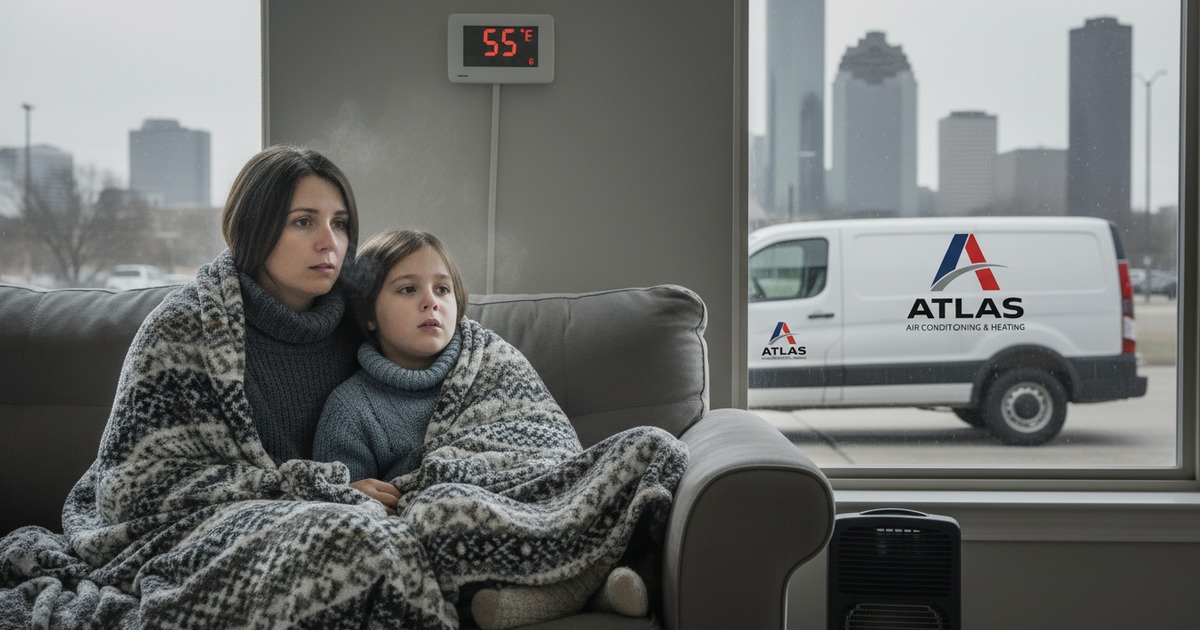
Heating Emergency
Heater Won't Turn On?
Houston cold snaps hit fast. If your heater isn't responding, here's what to check before temperatures drop further.
What's Going On
Understanding the Problem
You've set the thermostat to heat, but nothing happens — no warm air from the vents, no sound from the furnace. Houston heating emergencies are less frequent than cooling ones, but when a cold front drops temperatures into the 20s–30s, a non-working heater becomes serious fast — especially for homes with elderly residents, young children, or pets.
Diagnosis
Common Causes
1Thermostat not set to heat
After months of cooling mode, the thermostat may need to be manually switched to HEAT. Some thermostats also have a temperature differential that prevents the heater from starting until the room drops a certain amount below the set point.
2Pilot light out (older furnaces)
If you have an older furnace with a standing pilot light, it may have gone out. Without the pilot, the furnace won't ignite. Newer furnaces use electronic ignition, which has its own failure modes.
3Ignitor failure (newer furnaces)
Modern furnaces use a hot surface ignitor — a small ceramic element that glows red-hot to light the gas. These are fragile and crack over time. When the ignitor fails, the furnace tries to start but can't light.
4Tripped safety switch
Furnaces have several safety switches — flame sensor, high-limit switch, pressure switch. If any of these detect an unsafe condition, they shut the furnace down. This is protective but means the underlying issue needs to be fixed.
5Clogged furnace filter
Yes, filters affect heating too. A severely clogged filter restricts airflow, causing the furnace to overheat. The high-limit safety switch trips and shuts everything down.
6Gas supply issue
If the gas valve is closed, the gas line has an issue, or you've run out of propane (for propane furnaces), there's no fuel to burn. Check that other gas appliances (stove, water heater) are working.
DIY Troubleshooting
What You Can Try
Check the thermostat
Switch it to HEAT and set the temperature at least 5 degrees above the current room temperature. Make sure it's not in a programming schedule that has the heat off. Replace batteries if the screen is dim.
Check the circuit breaker
Even gas furnaces need electricity for the blower, ignitor, and controls. Make sure the breaker labeled for the furnace or air handler is on.
Check the furnace switch
There's usually a light switch on the wall near the furnace that controls power to the unit. It looks like a regular light switch and is easy to accidentally flip off. Make sure it's on.
Replace the air filter
If the filter is clogged, the high-limit switch may have tripped. Replace the filter, then turn the system off for 5 minutes and back on to reset the safety switch.
Check if gas is flowing
Try turning on another gas appliance (stove burner, water heater) to verify gas is flowing to the house. If nothing gas-powered is working, the issue is your gas supply, not the furnace.
Know When to Call
When to Call a Pro
If you smell gas, leave the house immediately and call your gas company and 911 — don't flip any switches or use your phone inside. For non-gas-smell situations: if the furnace clicks or tries to start but won't light, if you've checked everything on this list with no improvement, or if the furnace starts and shuts off within a few seconds (short cycling), call us.
Pro Tip
Houston homeowners often forget to test their heater before cold season hits because our winters are so mild. Run your heater for 15 minutes in October or November before you actually need it. A burning dust smell is normal for the first run of the season — it's dust on the heat exchanger burning off. But if the smell persists or smells like rotten eggs (gas), shut it off.
More Troubleshooting